 how-to
Citrus Tree Fertilizer for Alkaline Soil: 2026 Guide
Table of Contents
- Why Alkaline Soil Blocks Nutrient Uptake in Citrus Trees
- Citrus Tree Micronutrient Deficiency: Symptoms and Diagnosis
- How to Lower Soil pH for Citrus: Step-by-Step Protocol
- Choosing the Right Fertilizer for Alkaline Soil
- Best Time to Fertilize Citrus Trees in Alkaline Conditions
- Application Rates and Methods for In-Ground vs. Container Citrus
- Water Quality and Its Impact on Soil pH
- Conclusion
- Frequently Asked Questions
Last Updated: September 21, 2026
Why Alkaline Soil Blocks Nutrient Uptake in Citrus Trees
Alkaline soil is ground with a pH above 7.0, and it causes nutrient lockout in citrus trees. The nutrients are present in the soil. The tree just cannot reach them.
This is the core problem behind most sad citrus trees in desert yards.
A few things make this worse in desert yards:
- Calcium carbonate in native soil and irrigation water pushes pH up
- Low rainfall means minerals never leach out
- Hard water adds more alkalinity with every watering
Citrus Tree Micronutrient Deficiency: Symptoms and Diagnosis
Citrus tree micronutrient deficiency shows up first in the leaves. Iron, zinc, and manganese are the usual suspects in alkaline soil.
Reading the Leaves: A Visual Diagnostic Guide
Use this quick guide to match what you see to the likely cause:
| What You See | Likely Deficiency | Where It Shows |
|---|---|---|
| Yellow between green veins, new leaves | Iron | Top of tree |
| Small, narrow leaves, short twigs | Zinc | New growth |
| Faded tissue, green veins, dull color | Manganese | Mid-canopy |
| Yellow edges, older leaves first | Magnesium | Lower canopy |
| Overall pale, stunted growth | Nitrogen | Whole tree |
How to Lower Soil pH for Citrus: Step-by-Step Protocol
Lowering pH is a chemistry project, not a weekend chore. Elemental sulfur does not acidify soil on its own, soil bacteria (chiefly Thiobacillus species) oxidize it to sulfuric acid over weeks to months. That reaction needs warm, moist, biologically active soil, which is why sulfur applied in cold or bone-dry conditions sits inert. If your soil is sterile or hydrophobic, the sulfur will not work no matter how much you add.
- Test your soil first. Use a home kit or send a sample to a lab. You need your starting pH, plus a sense of your soil texture, sandy soil buffers weakly and shifts fast, clay buffers hard and resists change.
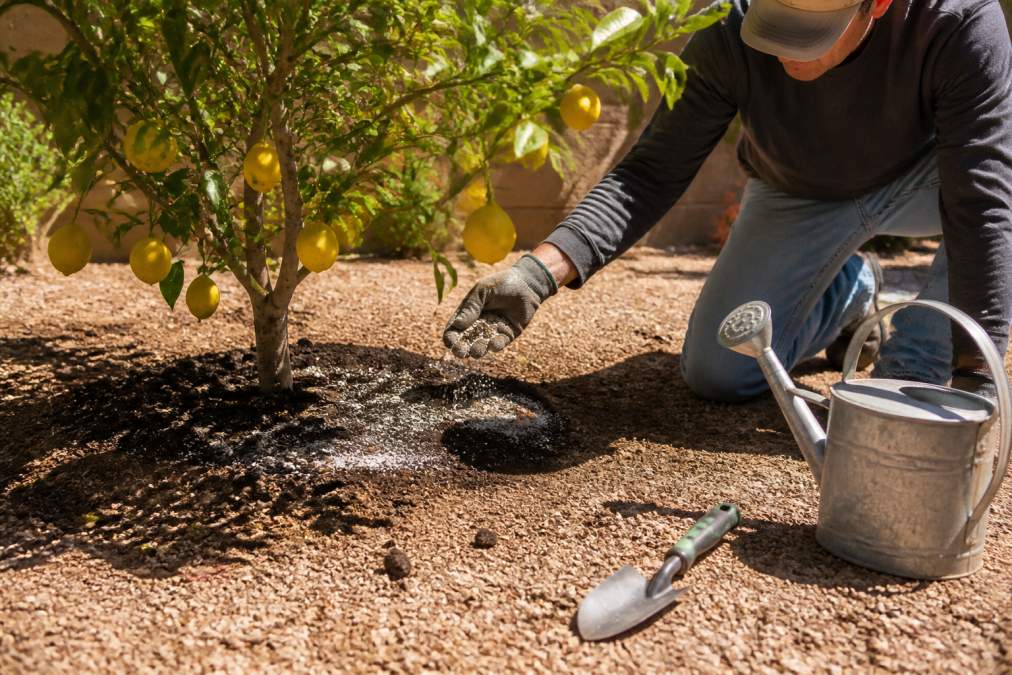
- Apply elemental sulfur for lasting change. A common extension guideline is roughly 1 pound of elemental sulfur per 100 square feet to drop pH by about half a point in sandy soil, and up to 2 to 3 times that amount in heavy clay. Work it into the top few inches, surface-applied sulfur barely moves.
- Use ammonium sulfate for a faster, gentler shift. It acidifies as the ammonium converts to nitrate, and it feeds nitrogen at the same time. It is a good short-term tool but a poor long-term fix because it does not build residual acidity the way elemental sulfur does.
- Skip gypsum if your goal is pH. Gypsum (calcium sulfate) improves sodic clay structure and flushes sodium, but it does not lower pH. Many homeowners confuse the two. If your problem is high pH from calcium carbonate, gypsum will not help.
- Add organic matter. Compost and peat improve cation exchange capacity, which helps soil hold nutrients and buffers pH swings. Peat moss itself is acidic (often pH 3.5 to 4.5) and gives a mild local shift, but it decomposes and the effect fades.
- Re-test every 8 to 12 weeks. Track progress and adjust. Do not expect a one-point drop in a single season in calcareous soil.
- Mulch the root zone. A 3- to 4-inch layer keeps moisture steady, feeds soil biology, and buffers pH swings.
Organic vs. Synthetic Acidification Methods
Both work. They just work differently, and the trade-offs matter for long-term soil health.
A Note on Foliar and Chelate Shortcuts
If your tree is actively chlorotic, do not wait months for soil sulfur to work. A foliar spray of chelated iron or a soil drench of iron EDDHA can green up new growth within two to three weeks while the slower soil correction proceeds underneath. Treat the soil fix and the symptom fix as parallel tracks, not sequential ones.
Schedule a Free In-Home Estimate →
Choosing the Right Fertilizer for Alkaline Soil
The right citrus tree fertilizer for alkaline soil does two jobs. It feeds the tree and it fights the pH problem.
Look for these features:
- Chelated micronutrients that stay available at high pH
- A balanced N-P-K ratio suited to citrus, often close to 2-1-1
- Slow-release fertilizer to avoid salt spikes
- Added iron, zinc, and manganese
Chelated Iron and Other Key Micronutrients
Chelated iron is iron wrapped in a molecule that keeps it soluble. This matters in high pH soil where plain iron locks up fast.
Other micronutrients to check on the label:
- Zinc for leaf size and twig growth
- Manganese for healthy green tissue
- Magnesium for fruit quality
Best Time to Fertilize Citrus Trees in Alkaline Conditions
The best time to fertilize citrus trees is late winter into early spring, just before new growth starts. In warm desert climates, that means February through March.
Application Rates and Methods for In-Ground vs. Container Citrus
In-ground and container trees need different approaches. The root zone is the key difference.
A few rules that apply to both:
Schedule a Free In-Home Estimate →
- Always water before and after feeding
- Never let fertilizer touch the trunk
- Reduce the dose for young or stressed trees
Application frequency:
- In-ground: 3 feedings per year
- Containers: every 6 to 8 weeks during the growing season
- Foliar sprays: as needed when symptoms appear
Water Quality and Its Impact on Soil pH
This is the section most guides skip, and it is the reason many homeowners never win the alkaline-soil battle. Your irrigation water can undo every amendment you apply. If you acidify the soil and then water with high-alkalinity water, the next irrigation pushes pH right back up.
What to Look For on a Water Test
- Total alkalinity (as CaCO₃): the main driver of pH rebound. Above ~150 ppm, expect ongoing acidification needs.
- Hardness (calcium + magnesium): high hardness often travels with high alkalinity, though they are not the same thing.
- Sodium and chloride: high levels stress citrus directly and worsen salt buildup in containers.
- pH: useful but far less informative than alkalinity for soil management.
Practical Ways to Counteract Hard Water
- Acidify your irrigation water. Injecting a small amount of acid (commonly sulfuric or citric for home use) to bring water pH down to roughly 5.5 to 6.5 neutralizes bicarbonates before they hit the soil. This is the single most effective long-term fix in hard-water regions. Do not attempt acid injection without proper safety gear and a way to measure the result.
- Use acid-forming fertilizers. Ammonium sulfate and urea-based products acidify the root zone as they break down, partially offsetting water alkalinity.
- Water deeply and less often. Fewer, deeper irrigations deliver the same moisture with less total salt and bicarbonate load than frequent shallow watering.
- Flush container trees regularly. In pots, salts and bicarbonates concentrate fast. Flush with plain water until it runs freely from the drainage holes every few months, then resume feeding.
- Consider a different water source for containers. Collected rainwater or filtered water for potted citrus removes the alkalinity problem entirely.
- Apply chelated micronutrients on a schedule. When water keeps pH high, iron, zinc, and manganese lock up faster. Regular chelate applications (iron EDDHA or DTPA) keep them available between soil corrections.
Why This Changes Your Fertilizer Plan
If your water runs high in alkalinity, your fertilizer strategy has to assume pH will drift upward between applications. That means:
- Choose fertilizers with chelated micronutrients rather than sulfate or oxide forms.
- Budget for more frequent acidification than a guide written for rainwater or low-alkalinity regions would suggest.
- Re-test soil pH more often, every 8 to 12 weeks rather than annually, because your baseline is moving.
Conclusion
Fixing alkaline soil for citrus is a marathon, not a sprint. Test first, correct the pH slowly, and feed with chelated nutrients that survive high pH. Do those three things and your tree will reward you.
Frequently Asked Questions
Which fertilizer is best for alkaline soil?
For alkaline soil, choose acid-forming fertilizers that contain chelated iron (such as iron DTPA) and ammonium sulfate or urea as nitrogen sources. These help lower pH and make nutrients available. A fertilizer with an N-P-K ratio like 12-0-12 or 15-5-10 plus micronutrients works well. Avoid nitrate-based fertilizers that raise pH. Always test your soil first to confirm alkalinity and nutrient gaps.
Do citrus trees like acid or alkaline soil?
Citrus trees prefer slightly acidic soil with a pH between 5.5 and 6.5. In alkaline soil (pH above 7.0), essential nutrients like iron, zinc, and manganese become locked up and unavailable to the tree, leading to deficiencies and yellowing leaves. While citrus can survive in mildly alkaline conditions, they thrive when the soil pH is in the ideal range. Regular soil testing helps you monitor and adjust pH as needed.
How do I lower the pH of my soil for citrus trees?
To lower soil pH for citrus, apply elemental sulfur or ammonium sulfate according to soil test recommendations. Elemental sulfur is slow-acting but long-lasting; ammonium sulfate provides a quicker pH drop plus nitrogen. For container trees, use a soil mix with peat moss and fertilize with acid-forming products. Avoid over-application, which can harm roots. Re-test pH every 3-6 months and adjust gradually.
Why are my citrus tree leaves turning yellow in alkaline soil?
Yellowing leaves in alkaline soil typically indicate iron chlorosis, where high pH locks up iron, causing interveinal yellowing (yellow between green veins) on new leaves. Other micronutrient deficiencies like zinc or manganese can also cause yellowing. To fix it, apply chelated iron (iron DTPA) as a soil drench or foliar spray, and work on lowering soil pH long-term with elemental sulfur or acid-based fertilizers.