 ultimate-guide
Pest Control Guarantee Explained: What's Covered in 2026
Table of Contents
- What a Pest Control Guarantee Actually Covers
- What to Look for in Pest Control Contracts
- Common Pest Control Contract Exclusions
- How a Re-Treatment Policy for Pest Control Works
- Premium vs. Basic Plans: A Cost-Benefit Analysis
- How to Resolve Disputes With Your Pest Control Provider
- Step 1: Document Everything Before You Call
- Step 2: Escalate in Writing, Not by Phone
- Step 3: File a Complaint With the State Licensing Board
- Step 4: Contact Your State Attorney General's Consumer Protection Division
- Step 5: Small Claims Court
- Step 6: Consider Arbitration, But Read the Clause First
- What to Ask Before a Dispute Ever Starts
- Frequently Asked Questions
Last Updated: September 27, 2026
What a Pest Control Guarantee Actually Covers
A pest control guarantee is a written promise from your provider to return and re-treat your property at no additional cost if covered pests come back within a set period. This guide breaks down what a pest control guarantee explained properly looks like, so you can tell the difference between real coverage and marketing language. Below, we'll show you exactly what to check before you sign.
The Difference Between a Guarantee and a Warranty
A guarantee is a service promise; a warranty is a contractual obligation with defined terms. In practice, providers use these words loosely, which is exactly where confusion starts. A guarantee usually means the company will come back and re-treat. A warranty, by contrast, spells out duration, transferability, and legal liability in writing. A termite bond is the clearest example: it's a warranty with a defined warranty period, renewal terms, and sometimes a repair allowance.
What to Look for in Pest Control Contracts
What to look for in pest control contracts comes down to five things: the pests covered, the treatment areas, the re-treatment trigger, the contract length, and the cancellation terms. Miss any one of these and you're signing blind.
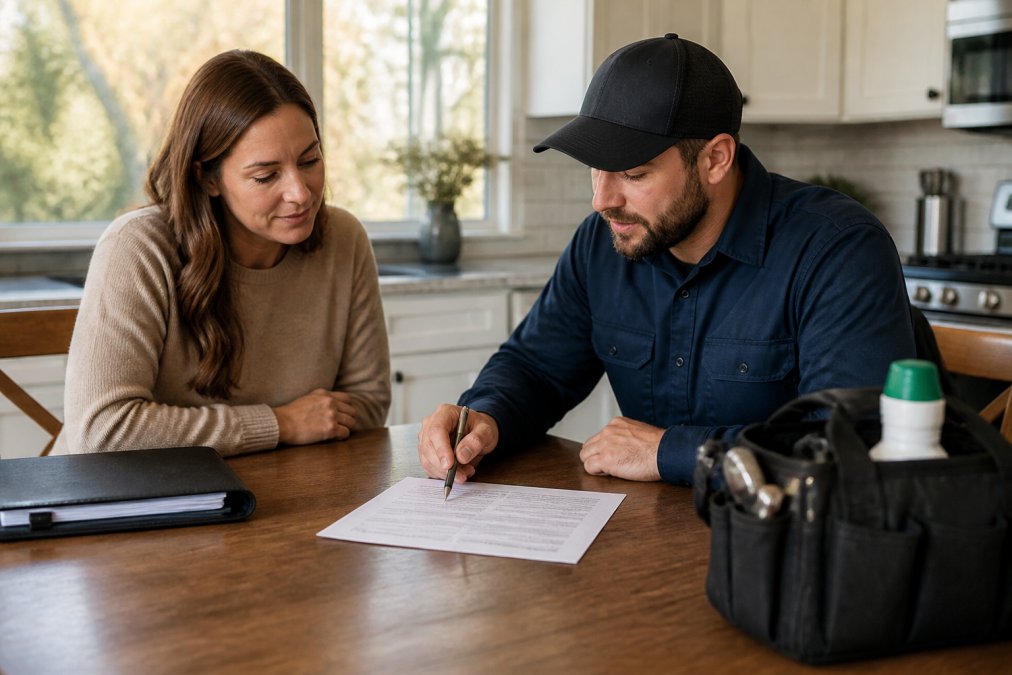
Before signing, confirm these basics in writing:
- Pest identification: Which specific pests are named, not "general pests"
- Service scope: Interior, exterior, or perimeter only
- Service frequency: Monthly, quarterly, or as-needed
- Re-treatment trigger: What counts as pest activity, and who decides
- Contract terms: Length, auto-renewal, and cancellation notice
The Fine Print Checklist
Use this checklist before you sign anything:
- Are the covered pests listed by name?
- Is the re-treatment window stated in days, not "as needed"?
- Does the contract auto-renew, and how much notice is required to cancel?
- Are exclusion clauses clearly marked?
- Is there a money-back promise, or only free re-treatment?
- Is the licensed applicator's name and license number on the document?
Common Pest Control Contract Exclusions
Pest control contract exclusions are the clauses that void your coverage, and they're rarely highlighted. A common mistake is assuming "guaranteed" means "no matter what." It doesn't.
Typical exclusions include:
- New construction or recently disturbed soil
- Pre-existing damage or untreated structural gaps
- Pest activity in areas outside the service scope
- Homeowner-caused conditions like standing water or exposed food
- Third-party work that disrupts the treated barrier
Pest-Specific Warranty Limitations
Termite bonds often carry the strongest warranty coverage because the damage risk is structural. Scorpion and rodent coverage usually depends on exclusion work being completed first. Mosquito programs are seasonal and rarely carry a year-round guarantee. Ask your provider to state, in writing, which pests carry full warranty coverage and which are limited.
How a Re-Treatment Policy for Pest Control Works
A re-treatment policy for pest control defines when the company returns for free and when it charges. The trigger is almost always verified pest activity within the warranty period, confirmed by a technician during a routine inspection.
- You notice pest activity and submit a service call. Most contracts require notice within a set window after you first observe the problem.
- The provider schedules within the service window. Standard residential contracts often promise service within a set number of business days for non-emergency pests, and a shorter timeframe for pests classified as urgent (rodents, stinging insects, bed bugs).
- A licensed applicator confirms the pest identification. This is the decision point. The technician's identification, not yours, determines whether the pest is covered. If you call about "ants" and the technician identifies carpenter ants, and your contract only names odorous house ants, the re-treatment may be billable.
- If covered, re-application happens at no charge. Free re-treatment usually means labor and the standard product application. It does not automatically include exclusion work (sealing entry points), structural repairs, or a different product class.
- If excluded, you receive a quote before any work begins. A reputable provider gives you a written estimate and waits for approval. A provider that performs the work first and invoices after is a red flag worth documenting.
What "Verified Activity" Actually Means
Most contracts define verified activity as a technician's on-site confirmation of live pests, fresh droppings, or new damage consistent with the covered species. Old droppings, shed skins, or evidence that predates the service visit typically do not count. This is why dated photos matter: they establish a timeline the provider cannot dispute.
The Re-Treatment Window: Days, Not Adjectives
A strong contract states the re-treatment window in days. Common structures include:
- 30-day window, typical for one-time general pest treatments
- 90-day window, common on quarterly service plans
- Continuous coverage, the warranty stays active as long as you keep paying for scheduled service; miss a payment or skip a service and coverage lapses
When Re-Treatment Is Not Free
Even inside an active warranty, providers commonly bill for:
- Re-treatment of a pest not named in the contract
- Re-treatment after you skipped a scheduled service visit
- Re-treatment in an area you declined to have treated (for example, refusing interior service)
- Re-treatment following third-party work that disturbed the treated barrier
- Emergency or after-hours calls outside the standard service window
Knowing these carve-outs before you sign is the difference between a guarantee that works and one that only sounds like it does.
Premium vs. Basic Plans: A Cost-Benefit Analysis
Premium plans cost more because they cover more pests, more frequent service, and broader warranty coverage. Basic plans handle a narrow pest list with a shorter warranty period. Neither is automatically better; it depends on your property and your risk tolerance.
Schedule a Free In-Home Estimate →
| Feature | Basic Plan | Premium Plan |
|---|---|---|
| Covered pests | 1-2 common pests | Multiple, including seasonal |
| Service frequency | Quarterly | Monthly or bi-monthly |
| Re-treatment window | Shorter | Extended |
| Exclusion work | Not included | Often included |
| Best for | Low-risk properties | Scorpion, termite, rodent zones |
How to Resolve Disputes With Your Pest Control Provider
Dispute resolution procedures should be spelled out in your contract before a problem arises. If they aren't, you're relying on goodwill, which is a bad backup plan.
Step 1: Document Everything Before You Call
Build a paper trail from day one. Gather:
- The signed service agreement and any addenda
- Every service report the technician left behind
- Dated photos of pest activity and any damage
- A written log of calls: date, time, who you spoke with, what was promised
- Receipts and payment records
A dispute with no documentation is a he-said-she-said. A dispute with a folder is a case.
Step 2: Escalate in Writing, Not by Phone
Call the company first, but follow up with an email or letter that restates the issue and cites the specific contract clause you believe was breached. Written notice creates a record and often moves a stalled complaint to a supervisor. Give the provider a reasonable window, 10 to 14 business days is a common standard, to respond before escalating.
Step 3: File a Complaint With the State Licensing Board
Structural pest control is regulated at the state level. Every state has a regulatory body, often a department of agriculture, a structural pest control board, or a consumer affairs division, that licenses applicators and handles complaints against them. Filing a complaint is typically free. The board can investigate, require the company to respond, and in serious cases suspend or revoke a license.
Step 4: Contact Your State Attorney General's Consumer Protection Division
If the licensing board can't resolve it, or if the issue involves deceptive advertising rather than a licensing violation, the attorney general's consumer protection office is the next stop. These offices collect complaints, mediate some disputes, and build patterns of complaints that can trigger broader enforcement. Filing is free and can be done online in most states.
Step 5: Small Claims Court
For disputes over money, a refund you were promised, a re-treatment you were billed for that should have been free, small claims court is often the fastest and cheapest path. Filing fees are typically modest, the dollar limit varies by state (commonly in the low thousands to around ten thousand dollars), and you generally don't need a lawyer.
Step 6: Consider Arbitration, But Read the Clause First
Many pest control contracts contain a mandatory arbitration clause. If yours does, you may be required to resolve the dispute through a private arbitrator rather than court. Arbitration can be faster than litigation but often limits your ability to appeal. Read this clause before you sign, not after a dispute starts.
What to Ask Before a Dispute Ever Starts
- Does the contract state a specific complaint procedure and timeline?
- Is there an arbitration clause, and does it waive your right to court?
- Is the company's license number printed on the agreement?
- Does the contract promise a refund, or only free re-treatment?
Frequently Asked Questions
Does a pest control guarantee cover re-treatment costs?
Most pest control guarantees include re-treatment at no extra charge if covered pests return within the warranty period. However, the re-treatment policy for pest control varies by company. Some providers offer unlimited free re-treatments, while others limit the number of service calls or require you to pay for materials. Always confirm whether re-treatment is fully covered or if there are associated fees before signing a contract.
What is typically included in a standard pest control service guarantee?
A standard pest control guarantee usually covers common household pests like ants, roaches, and spiders. It includes free re-treatment if pests return between scheduled visits, provided you maintain your service agreement. The guarantee often requires regular preventative maintenance and may exclude pests that need specialized treatments, such as termites or bed bugs. Review your contract to understand the exact scope of coverage.
What are the most common pest control contract exclusions?
Common pest control contract exclusions include damage caused by pests (like wood rot from termites), pests that require separate treatment programs (such as bed bugs or wildlife), and infestations resulting from poor sanitation or structural issues. Many contracts also exclude pests not listed in the service agreement. Understanding these exclusions helps you avoid surprise charges and know when to request additional services.
How do I know if a pest control company's guarantee is legitimate?
A legitimate pest control guarantee is written clearly in your service agreement, specifies which pests are covered, outlines the warranty period, and explains the re-treatment process. Look for a company that provides a written copy before you pay, doesn't pressure you into signing, and has verifiable reviews. Check if the guarantee requires you to waive certain rights or if it has hidden conditions that make it difficult to claim.
Pest problems don't wait, and neither should your protection. Local Choice Pest & Landscape Nutrition offers guaranteed results, background-checked technicians, and treatments safe for kids, pets, and desert wildlife, all backed by a re-treatment promise that means if pests come back, so do we. We're family-owned, we schedule fast, and we put our guarantee in writing. Get started with Local Choice Pest & Landscape Nutrition and schedule a free in-home estimate today.