 comparison
Is Professional Tree Care Worth It in Cave Creek?
Table of Contents
- Why Cave Creek Trees Face Unique Pressure
- Signs a Tree Needs Professional Care
- DIY Tree Trimming vs Professional Service: The Real Trade-Offs
- What Drives Tree Trimming Cost in Cave Creek AZ
- Questions to Ask a Tree Care Company Before You Hire
- When Professional Tree Care Pays for Itself (and When It Doesn't)
- Conclusion: Making the Call for Your Property
- Frequently Asked Questions
Last Updated: October 12, 2026
Why Cave Creek Trees Face Unique Pressure
Cave Creek sits at the edge of the Sonoran Desert, and that location puts every tree on your property under stress that trees in wetter climates never face. Deciding whether is professional tree care worth it in Cave Creek starts with understanding that pressure. Summer highs push past 110°F, annual rainfall often lands in single digits, and the soil is thin, alkaline, and quick to dry out.
At Local Choice Pest & Landscape Nutrition, we work on Cave Creek properties every week, and the pattern is consistent: trees that look fine in spring can be struggling badly by July. Native species like mesquite, palo verde, and ironwood evolved for this climate, but they still break under drought stress, monsoon winds, and poor pruning.
Monsoon season is the real test. Storms roll in fast, and a tree with weak branch attachments or a lopsided canopy becomes a hazard within minutes. Add in the fact that many Cave Creek lots sit on rocky, sloped ground, and you have conditions where a falling limb can damage a roof, a fence, or a parked car.
That's the context for every decision that follows.
Signs a Tree Needs Professional Care
The clearest sign a tree needs professional care is a structural defect you can see from the ground: dead limbs, cracks, a leaning trunk, or a canopy that's thinning on one side. If you spot any of these, get an assessment before storm season.
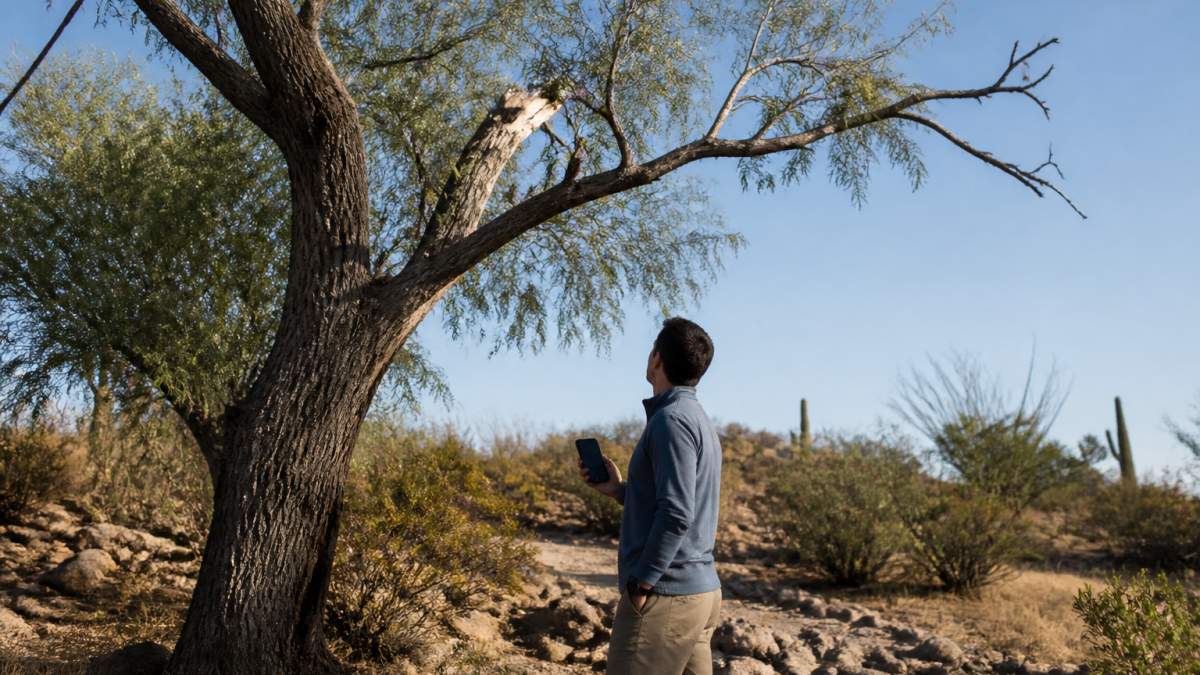
Structural Red Flags You Can Spot From the Ground
Walk your property after any wind event and check for these:
- Dead or hanging limbs that haven't leafed out while the rest of the tree has
- Cracks or splits in the trunk or where a major branch meets it
- A new lean that wasn't there last season
- Fungal growth at the base, which often signals internal decay
- Bark peeling in large sheets rather than normal shedding
A common mistake is assuming a dead limb will just fall off harmlessly. On a mature mesquite, a limb can weigh hundreds of pounds and land on whatever is beneath it.
Desert-Specific Warning Signs
Desert trees show stress differently than trees back east. Watch for sunburned bark on the southwest side of the trunk, canopy dieback that starts at the tips, and sap oozing from the trunk. Palo verde and mesquite are also prone to mistletoe, a parasitic plant that saps nutrients and spreads if you ignore it.
What most guides miss is that overwatering causes as much damage here as underwatering. Trees adapted to desert conditions develop shallow, wide root systems, and constant irrigation rots those roots. If your tree is declining and you water it daily, the fix may be less water, not more.
DIY Tree Trimming vs Professional Service: The Real Trade-Offs
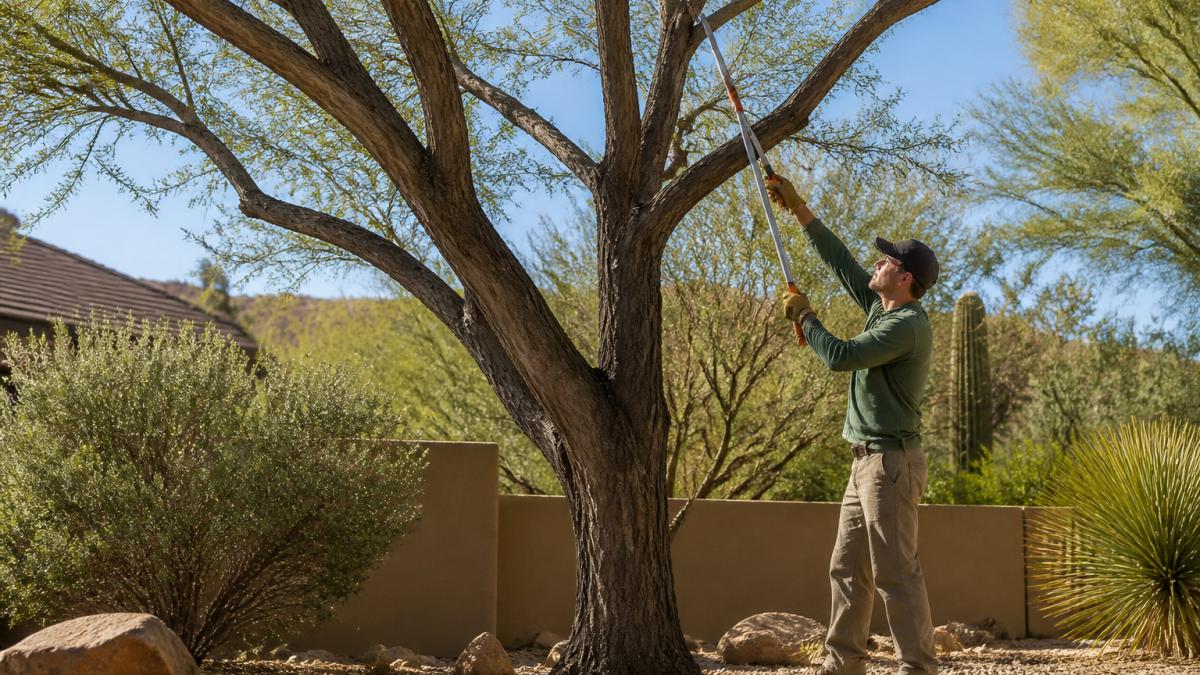
DIY tree trimming makes sense for small, low branches you can reach safely from the ground with hand tools. Professional service makes sense for anything involving a ladder, a chainsaw above shoulder height, or a limb near a structure or power line.
Schedule a Free In-Home Estimate →
The trade-off isn't really about money. It's about what happens when something goes wrong. A homeowner trimming a branch over a roofline risks a hospital visit and a repair bill. A trained crew carries insurance, knows how a cut affects the tree's long-term health, and can spot problems you'd never notice.
Where DIY genuinely works:
- Removing suckers and small water sprouts
- Cutting back dead growth on shrubs and small ornamentals
- Clearing low branches on young, established trees
Where it doesn't:
- Anything requiring a ladder or climbing
- Limbs within ten feet of a power line (call the utility, not a trimmer)
- Large removals or anything over a structure
- Trees showing disease or structural defects
Tree work is also one of the more dangerous jobs in the country. The Occupational Safety and Health Administration guidance on tree care hazards outlines risks that range from falls to chainsaw injuries to electrocution, which is why licensed and insured crews exist.
What Drives Tree Trimming Cost in Cave Creek AZ
Tree trimming cost in Cave Creek AZ depends on tree size, species, accessibility, and how much debris needs hauling. A small ornamental pruned from the ground costs far less than a mature mesquite over a roofline that requires climbing and rigging.
The factors that move the number most:
- Height and canopy spread. Bigger trees need more time, more equipment, and more crew.
- Access. A tree in an open yard is cheaper to work on than one wedged between a fence and a pool.
- Species and wood density. Dense desert hardwoods cut slower than softwoods.
- Condition. Dead, cracked, or storm-damaged trees take longer and carry more risk.
- Debris removal. Hauling and chipping adds cost; leaving the wood on site reduces it.
Why Two Quotes for the Same Tree Can Differ by Hundreds
Two companies can quote the same tree very differently, and it usually comes down to what's included. One quote may cover trimming only; another includes cleanup, stump grinding, and disposal. One may carry full insurance and certified staff; another may not.
Ask each company to itemize. A low quote that leaves you hauling branches or that comes from an uninsured crew isn't actually cheaper once you factor in the risk.
Questions to Ask a Tree Care Company Before You Hire
Ask any tree care company five things before you hire: proof of insurance, arborist credentials, a written scope of work, how they handle cleanup, and what happens if the work goes wrong. The answers separate a real professional from a pickup truck and a chainsaw.
Run through this checklist:
- Can you show a certificate of insurance for liability and workers' compensation?
- Who will actually do the work, and are they trained and background-checked?
- Is the quote written, itemized, and clear about what's included?
- Do you haul away all debris, or is that extra?
- What's your policy if a limb damages my property during the job?
If a company hesitates on insurance or won't put the scope in writing, that's your answer. Move on.
Schedule a Free In-Home Estimate →
When Professional Tree Care Pays for Itself (and When It Doesn't)
Is professional tree care worth it in Cave Creek when it prevents a costly failure: a limb through a roof, a tree on a car, or a removal that becomes urgent and expensive after a storm. It also pays off in tree health, since correct pruning extends a tree's life and keeps it looking good, which matters for property value.
It's harder to justify for small, low-risk work you can safely do yourself. If a branch is within arm's reach and nowhere near a structure or line, handle it.
Here's a simple way to decide:
| Situation | DIY or Professional | Why |
|---|---|---|
| Small low branches, hand tools only | DIY | Low risk, no climbing needed |
| Limbs near a roof or power line | Professional | Fall and electrocution risk |
| Large removals or storm damage | Professional | Equipment, insurance, and skill required |
| Trees with disease or structural cracks | Professional | Needs diagnosis and correct treatment |
| Suckers and light shrub cleanup | DIY | Easy, safe, low stakes |
The pattern is straightforward: the higher the tree, the closer it is to something valuable, and the worse its condition, the more professional care earns its cost.
Conclusion: Making the Call for Your Property
Every Cave Creek property is different, and the right call depends on your trees, your risk tolerance, and your budget. What doesn't change is the value of an honest assessment before you commit to a plan.
At Local Choice Pest & Landscape Nutrition, we're a family-owned Arizona team that handles both tree and shrub care and landscape nutrition, using products safe for kids, pets, and desert wildlife. Our background-checked technicians offer fast scheduling and guaranteed results: if pests come back, so do we. Schedule a free in-home estimate and get a clear read on what your trees actually need.
Frequently Asked Questions
Is it worth hiring a professional to trim trees in Cave Creek?
For most Cave Creek homeowners, yes. Desert trees like mesquite and palo verde have growth patterns that respond poorly to improper cuts, and a bad trim can leave a tree vulnerable to sunscald, pests, and storm damage. Professional tree care in Cave Creek also covers the liability question: if a limb you cut falls on a neighbor's roof or car, your homeowner's insurance may not cover it. Certified arborists carry insurance and know how to shape desert species without shocking them.
How much does tree trimming cost in Cave Creek, AZ?
Tree trimming cost in Cave Creek AZ depends on tree height, canopy spread, species, access to the tree, and how much debris needs hauling. A small ornamental trim runs less than a large mesquite removal, and trees near power lines or structures add complexity. Most companies quote per job rather than per hour. Local Choice Pest & Landscape Nutrition provides free estimates so you get a firm number before any work starts.
What are the risks of trimming a tree yourself?
The biggest risks are falls, chainsaw injuries, and permanent damage to the tree. Desert species are especially unforgiving: cutting into the branch collar or leaving stubs invites borers and fungal infections that can kill a mature tree within a season. There's also the legal side. In Arizona, you can be held liable for damage your cut limbs cause to a neighbor's property. For anything above 10 feet or near a structure, the DIY savings rarely justify the exposure.
What should I look for when choosing a tree care company in Cave Creek?
Ask four things: Are the technicians certified arborists or supervised by one? Do they carry general liability and workers' comp insurance? Will they provide a written scope of work before starting? And what happens if the tree dies or the problem returns? A company that hesitates on any of these is a risk. Local Choice Pest & Landscape Nutrition is family-owned, uses background-checked technicians, and backs its work with a guarantee: if pests or problems come back, so do they.