 comparison
Pest Control vs Landscape Service Cost: 2026 Comparison
Table of Contents
- Pest Control vs Landscape Service Cost: What Each Dollar Actually Buys
- Pest Control Cost Per Month: What Drives the Number
- Landscape Maintenance Cost: Where the Money Goes
- Monthly vs. Annual Service Costs: Which Budgets Better
- Pest Control Service Plans: Contracts, Frequency, and Hidden Fees
- DIY Treatment vs Professional Service: The Real Break-Even Point
- Landscape Service Quote Comparison: How to Read Estimates Side by Side
- Bundling Pest and Landscape Plans: When It Saves Money
- Frequently Asked Questions
Last Updated: October 7, 2026
Pest Control vs Landscape Service Cost: What Each Dollar Actually Buys
The pest control vs landscape service cost comparison trips up more homeowners than almost any other property budget question, because the two line items look similar on a quote sheet and behave nothing alike in practice.
Here's the core distinction. Pest control is a treatment service: a technician applies products to eliminate or prevent insects, rodents, and other pests inside and around your home. Landscape service is a maintenance service: crews mow, trim, feed plants, and manage soil and irrigation to keep your yard healthy.
EPA guidance on safe pesticide use in and around homes frames pest treatments as regulated applications with defined intervals, which is why pest pricing is built around visit frequency rather than yard size alone.
Pest Control Cost Per Month: What Drives the Number
Pest control cost per month depends on three variables: treatment area size, infestation type and severity, and how often a technician returns. A one-time ant visit prices very differently from a year-round plan guarding against scorpions, termites, and rodents.
Published pricing guides give useful reference points. Angi's pest control cost guide reports one-time visits in the range of about $108 to $261 for a 1,500-square-foot home, while Better Termite's pest control pricing breakdown lists recurring monthly plans in the roughly $40 to $70 per-visit range, with termite treatments spanning a much wider band depending on method.
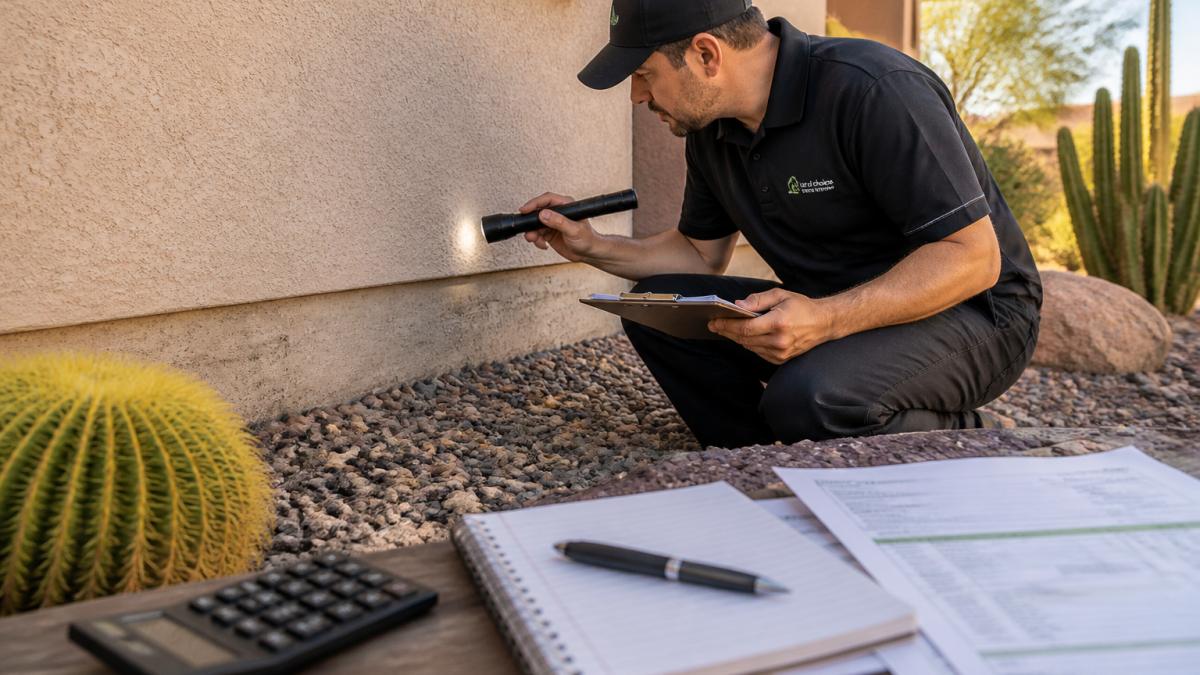
Property Size and Treatment Area
Square footage sets the baseline. A larger home has more perimeter to treat, more entry points to seal, and more interior space to cover. Exterior-only treatments cost less than full interior and exterior programs.
Pest Type and Severity
Routine preventive treatment for common insects sits at the low end. Active infestations, rodents, and wood-destroying pests push costs up through more product, more visits, and sometimes specialized methods.
Landscape Maintenance Cost: Where the Money Goes
Landscape maintenance cost is dominated by recurring labor, not products. Mowing, edging, trimming, and blowing account for the bulk of a standard visit, with fuel and equipment wear layered on top. That's why landscape quotes track yard size and complexity far more closely than pest quotes track house size.
Spring-Green's guide to pest control and lawn care costs notes that lawn and pest pricing both shift with the specific services selected, and that one-off jobs price differently from ongoing packages. A single mow is a transaction; a seasonal maintenance plan is a subscription.
Labor, Fuel, and Equipment
Crew time is the biggest line item: a half-acre lot with mature trees takes longer than a small, open yard. Fuel and power tool maintenance fold into every visit, rising with travel distance and yard count per route.
Plant Care and Garden Care Add-Ons
Fertilization, weed control, shrub trimming, and soil nutrition usually sit outside a basic mow-and-edge plan. Garden and plant care add-ons are where landscape budgets quietly grow, because healthy soil requires ongoing feeding, not a single application.
Monthly vs. Annual Service Costs: Which Budgets Better
Annual service almost always beats monthly billing for total spend, because providers discount prepaid agreements and monthly plans often carry a higher effective per-visit rate.
Schedule a Free In-Home Estimate →
For pest control, monthly service makes sense where pest pressure never fully stops. For landscape maintenance, a seasonal contract that ramps up in growing season and scales back in winter usually fits budgets better than a flat twelve-month rate.
To compare the two on equal footing, annualize everything. A pest plan at $50 per month costs $600 per year.
| Service | Monthly Billing (Typical) | Annual Prepay (Typical) | Annualized Monthly Equivalent |
|---|---|---|---|
| Pest control (exterior, monthly) | $40-$70 per visit | $450-$750 per year | $38-$63 |
| Pest control (interior + exterior, monthly) | $60-$100 per visit | $650-$1,100 per year | $54-$92 |
| Landscape maintenance (mow, edge, trim) | $120-$200 per visit, 8 months | $900-$1,500 per year | $75-$125 |
| Landscape maintenance (full service, 12 months) | $200-$350 per visit | $2,000-$3,500 per year | $167-$292 |
These ranges assume a typical suburban property with moderate pest pressure and a standard lawn; your quote will vary with region, lot size, and scope.
When comparing monthly versus annual, ask each provider for the total annual cost under both models.
For a like-for-like comparison, normalize both services to a cost per visit and per year. Pest control visits are shorter (30-45 minutes) and treatment-focused, while landscape visits run 1-2 hours and are maintenance-focused. That labor difference explains why landscape service usually costs more per visit but may visit less in winter.
Pest Control Service Plans: Contracts, Frequency, and Hidden Fees
Pest control service plans vary more than most homeowners expect, and the fine print is where budgets get surprised. True cost depends on visit frequency, what's covered between visits, and whether re-treatments cost extra.
Watch for these common contract terms:
- Initial fee vs. recurring fee: Many plans charge a higher first visit for the initial treatment, then a lower monthly rate. A typical initial fee ranges from $99 to $199, while recurring monthly visits run $40 to $70. Some companies waive the initial fee if you sign an annual contract.
- Re-treatment clauses: Confirm whether follow-up visits for the same pest are included or billed separately.
- Cancellation terms: Month-to-month plans are flexible; annual plans may carry early-termination charges equal to one or two months of service. Some contracts auto-renew unless you cancel 30 days before the renewal date.
- Coverage gaps: A plan labeled "general pest" may exclude termites, rodents, or specialty pests entirely. Termite treatments often require a separate contract with its own inspection fee and annual renewal.
- Seasonal surcharges: Some providers add fuel surcharges or holiday surcharges during peak season. Ask whether the quoted rate is locked for the contract term.
- Minimum service commitments: Some plans require a minimum of six months or twelve months, even if you cancel early. Others allow cancellation with 30 days' notice but charge a fee.
Landscape service contracts have their own hidden fees, but they tend to be simpler:
- Initial cleanup fee: A one-time charge for the first visit to bring overgrown property back to maintainable condition.
- Fuel surcharges: Some landscape companies add a fuel surcharge when gas prices rise above a certain threshold. Ask if the surcharge is capped.
- Snow removal or leaf removal add-ons: In colder regions, these are often separate contracts with their own per-visit or seasonal pricing.
- Irrigation start-up and blowout: If your landscape plan includes irrigation, expect separate fees for spring start-up and fall blowout.
When comparing pest control and landscape service contracts side by side, look at total first-year cost, not the monthly rate. Both may discount annual prepayment, but pest contracts often lock you in for twelve months while landscape contracts may be seasonal.
Pest control contracts are more likely to include auto-renewal clauses and early-termination fees than landscape contracts, which are often seasonal and easier to exit.
DIY Treatment vs Professional Service: The Real Break-Even Point
DIY treatment wins on sticker price and loses on almost everything else once you account for time, repeat applications, and product selection. Store-bought sprays and traps cost little per unit but rarely resolve recurring infestations, and the hours spent reapplying them add up fast.
The break-even point sits roughly where your time becomes worth more than the savings. If a recurring pest problem costs several weekends a season in reapplication and monitoring, a professional plan that resolves it in one or two visits is often cheaper in real terms.
What most DIY comparisons miss is that professional pest service includes inspection and diagnosis. A technician identifies the entry point or nesting site, which is the part a spray bottle can't do.
Schedule a Free In-Home Estimate →
Landscape Service Quote Comparison: How to Read Estimates Side by Side
Landscape service quote comparison comes down to normalizing scope before comparing price. Two quotes for "monthly lawn care" can mean entirely different things: one covers mowing only, the other mowing plus fertilization, weed control, and shrub trimming.
YourGreenPal's guide to comparing lawn care quotes recommends weighing price, included services, and reviews together rather than price alone. Use this checklist when reading estimates:
- Does the quote list every service included per visit?
- Is mowing, edging, and trimming all covered, or just mowing?
- Are fertilization and weed control included or billed separately?
- How many visits per month, and does that change by season?
- What's the cancellation policy and any early-termination fee?
- Is there a re-service guarantee if work is unsatisfactory?
Line up the quotes against the same checklist. The lowest number is rarely the best value once scope is equalized.
Bundling Pest and Landscape Plans: When It Saves Money
Bundling pest and landscape plans saves money when both services are genuinely needed on the same property, because a single provider spreads travel and scheduling costs across both jobs. The savings come from logistics, not discounted products.
Bundling makes the most sense for homeowners who want year-round pest protection and regular lawn maintenance from one crew, and less sense if you only need seasonal pest treatment or handle your own mowing.
At Local Choice Pest & Landscape Nutrition, we built our service around exactly this overlap.
Comparing pest control and landscape service costs isn't about finding the single cheapest line item; it's about matching each service to what your property actually needs.
Frequently Asked Questions
Is $70 a month good for pest control?
It depends on your property size, pest pressure, and what the plan covers. Published pricing guides report monthly pest control plans in a certain range. At that price, expect broader coverage such as ants, roaches, spiders, and rodents rather than a single-pest treatment. Ask whether the fee includes interior service, follow-up visits, and a guarantee if pests return before you judge the value.
Do landscapers do pest control?
Some do, but the scope differs. Lawn care providers typically treat turf and ornamental plants for insects and disease, which is pest and disease control for the landscape, not structural pest control inside your home. Ants, roaches, rats, and spiders that enter a building fall under a pest control license. If you want one provider for both, look for a company that holds the proper credentials for structural work, not just lawn treatment.
What does a typical pest control plan include?
Most recurring plans cover an initial pest inspection, exterior perimeter treatment, and scheduled visits through the year, with interior service on request. Common targets include ants, spiders, roaches, and rodents, with preventive treatment for seasonal pests. Termites, fleas, and bed bugs often sit outside a standard plan and carry separate pricing. Check the service agreement for the number of visits, the pests covered, and what happens if the problem returns between visits.
Should pest control and landscape services be bundled?
Bundling can cut total spending because one company handles overlapping work such as perimeter spraying and shrub treatment in a single visit. It also removes the finger-pointing that happens when a lawn problem and a pest problem share a cause. The trade-off is less flexibility to switch providers on one side. Compare the bundled quote against separate quotes line by line, and confirm the bundle covers both structural pests and landscape nutrition rather than one service wearing two labels.
What should I compare when reviewing pest control and landscape service quotes?
Put both quotes in the same format before deciding. List the service frequency, the treatment area in square feet, the specific pests or plants covered, and whether follow-up visits cost extra. Watch for one-time fees buried in annual contracts and for landscape quotes that exclude plant care or seasonal cleanup. A cheap per-visit rate on a plan with fewer visits can cost more per year than a higher monthly rate with full coverage.